
Puppy weight by age: a simple tracking guide
Learn how to track your puppy’s weight by age, which signs to watch at home and how to follow growth in a simple way.
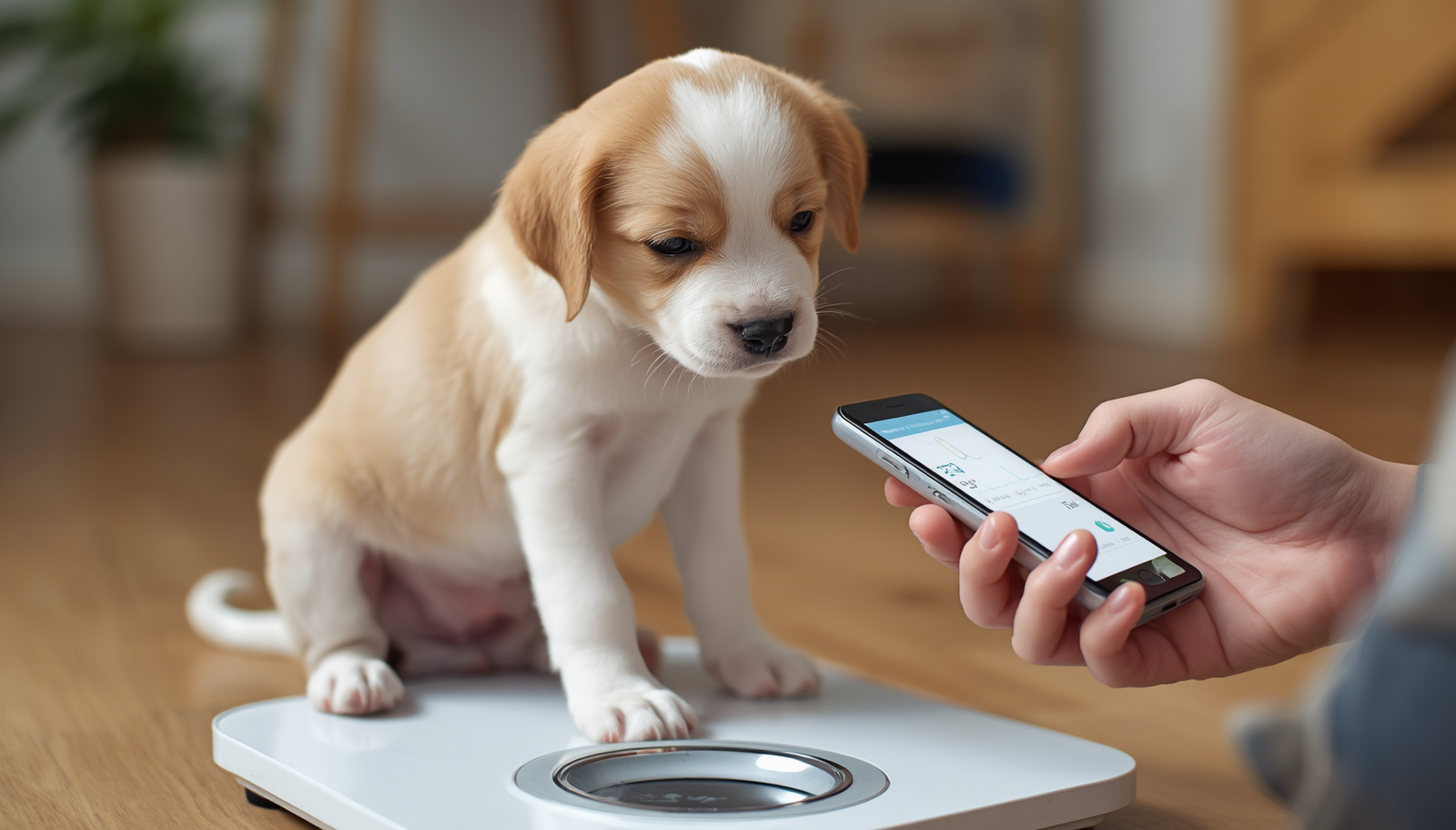
When a puppy comes home, one of the first questions that appears is very normal:
How much should my puppy weigh at this age?
And it makes sense.
During the first months, puppies grow very quickly. They seem to change almost from one week to the next: they eat more, sleep a lot, gain energy, get bigger and start developing their body.
But it is also a stage where it is easy to worry.
One day your puppy looks like they have grown a lot. Another day they seem thinner. Another day you are not sure if they are eating enough.
And then you start looking for weight charts, breed references or comparisons with other puppies.
Quick idea: Puppy weight by age is a guide, not an exact rule. What matters most is progress over time, not one isolated number.
Your puppy’s ideal weight depends on many factors: size, breed, genetics, food, health, activity and growth stage.
So instead of asking only how much your puppy should weigh, it is better to ask:
Is my puppy growing steadily and healthily?
With Peludio, you can save your puppy’s weight, review progress and see more clearly whether weight gain is stable.
*
Quick summary
🐾 Puppy weight changes quickly during the first months.
🐾 Not all puppies should weigh the same at the same age.
🐾 Breed, size and genetics have a big influence.
🐾 Progress over time matters more than one single number.
🐾 If there is weight loss, poor appetite or low energy, speak with your vet.
🐾 Tracking weight helps you notice changes earlier.
*
Why puppy weight changes so much
Puppies are in a full growth stage.
During the first months, their body is developing bones, muscles, organs, teeth and immune system. That is why they need energy, rest and suitable food.
At this stage, weight can change quite quickly.
A puppy may gain weight week by week, especially if they are a medium, large or giant breed.
But not all puppies grow at the same pace.
Some puppies gain weight very quickly at the beginning. Others grow more gradually. Mixed-breed puppies can be harder to estimate because you may not know what size they will be as adults.
That is why a chart can help, but it should not be treated as an absolute rule.
*
What affects a puppy’s weight
To understand whether a puppy’s weight is on track, you need to look beyond age.
Several factors can make a big difference:
🐾 Expected adult size.
🐾 Breed or breed mix.
🐾 Genetics from the parents.
🐾 Type of food.
🐾 Daily food amount.
🐾 Activity level.
🐾 Health status.
🐾 Internal or external parasites.
🐾 Digestive changes.
🐾 Exact growth stage.
For example, a small-breed puppy may get close to adult size much earlier than a large-breed puppy.
A large-breed puppy, on the other hand, may continue growing for longer and may need more extended tracking.
*
Puppy weight by age: a simple guide
There is no single number that works for every puppy.
But you can use a simple size-based guide to understand how weight usually evolves.
Small-breed puppies
Small-breed puppies often grow quickly during the first months and reach adult size earlier.
🐾 Weight gain may be faster at the beginning.
🐾 Adult weight is usually reached earlier than in large dogs.
🐾 A small weight change can matter more because the body is small.
🐾 It is important to avoid both excess weight and weight loss.
For small puppies, weighing regularly can help you notice small changes that may be relevant.
Medium-breed puppies
Medium-breed puppies usually have a more balanced growth pattern.
🐾 They gain weight progressively.
🐾 They may take longer than small dogs to finish growing.
🐾 Food and activity can influence progress a lot.
🐾 The weight trend matters more than one exact number.
For medium dogs, checking weight regularly helps confirm that growth is moving in a steady direction.
Large-breed puppies
Large and giant-breed puppies need special attention.
🐾 Their growth usually lasts longer.
🐾 They can gain a noticeable amount of weight over several months.
🐾 It is important to avoid growth that is too fast.
🐾 Food should be suitable for their size and life stage.
In these cases, it is best to follow your vet’s advice, because overly rapid growth may not be ideal for development.
*
How to know if your puppy is growing well
Weight is an important clue, but it is not the only one.
To understand whether your puppy is growing well, you can observe several signs.
🐾 Your puppy has energy and wants to play.
🐾 Your puppy eats normally.
🐾 Weight gain is progressive.
🐾 The ribs are not too visible.
🐾 The belly is not excessively swollen.
🐾 Stools are normal.
🐾 Your puppy sleeps a lot, but wakes up active.
🐾 The coat looks healthy.
🐾 Your vet confirms that progress looks good.
A healthy puppy does not need to look round or too thin.
They should look active, balanced and consistent with their expected size.
*
Signs you should pay attention to
During growth, there are some signs you should not ignore.
Some may be mild, but if they repeat or appear suddenly, it is better to ask your vet.
🐾 Weight loss.
🐾 Poor appetite.
🐾 Vomiting.
🐾 Diarrhoea.
🐾 Excessive tiredness.
🐾 Very swollen belly.
🐾 Very slow growth.
🐾 Loss of muscle mass.
🐾 Sudden behaviour changes.
🐾 No weight gain for several days or weeks.
This does not mean you need to panic over every small change.
But in puppies, quick changes deserve attention.
Their body is still developing, so it is better to act early if something does not seem right.
*
Why tracking your puppy’s weight is useful
When you see your puppy every day, it can be hard to notice how much they have grown.
Sometimes you only realise when you look at an old photo. Or when someone who has not seen your puppy for a while says: “Wow, they have grown so much!”
That is why tracking weight is so useful.
It helps you see progress more clearly.
With tracking, you can know:
🐾 How much your puppy weighed when they came home.
🐾 How much weight they gained in a week.
🐾 Whether weight is increasing steadily.
🐾 Whether there are unexpected drops.
🐾 Whether growth has slowed down.
🐾 Whether a new food is working well.
🐾 Whether you should speak with your vet.
Weight does not tell the whole story, but it is very helpful when read together with other information.
*
What to save together with puppy weight
Every time you weigh your puppy, you can save more than the number.
It does not need to be complicated. Adding context helps a lot.
You can save:
🐾 Weight date.
🐾 Puppy’s age.
🐾 Current weight.
🐾 Type of food.
🐾 Approximate daily food amount.
🐾 Recent food changes.
🐾 Activity level.
🐾 Mood or energy.
🐾 Vet check-ups.
🐾 Vaccines.
🐾 Deworming.
🐾 Progress photos.
For example, it is not the same to write:
“My puppy weighs 4 kilos.”
As it is to write:
“My puppy weighs 4 kilos, is 3 months old, eats well, is active and the vet says growth looks good.”
The second note tells a much more useful story.
*
How Peludio helps
Peludio can help you track your puppy’s growth in a simple way.
You can save weight, add photos, record vaccines, track deworming, save vet check-ups and keep important reminders in one place.
This is especially useful during the first months, because many things happen at the same time.
🐾 Weight changes.
🐾 Food changes.
🐾 First vaccines arrive.
🐾 Deworming is needed.
🐾 Vet check-ups happen.
🐾 New routines appear.
🐾 Your puppy grows very quickly.
With Peludio, all that information stays organised and easy to check when you need it.
*
Quick checklist to track your puppy’s weight
You can use this list as a simple guide:
🐾 Do I know how much my puppy weighs right now?
🐾 Do I have the previous weight written down?
🐾 Is my puppy gaining weight progressively?
🐾 Is my puppy eating normally?
🐾 Does my puppy have energy and want to play?
🐾 Are stools normal?
🐾 Have I saved progress photos?
🐾 Are vaccines under control?
🐾 Is deworming under control?
🐾 Do I know when the next vet check-up is due?
Mini tip: If you are not sure whether your puppy is growing well, do not rely only on a chart. Look at progress, observe energy and speak with your vet.
*
Conclusion
Knowing how much a puppy should weigh by age can help you understand growth better.
But weight should not be read on its own.
Every puppy has their own rhythm. Some grow quickly, others more slowly, and mixed-breed puppies can be harder to estimate.
The most useful thing is to:
🐾 Observe progress.
🐾 Record weight.
🐾 Save photos.
🐾 Track food and activity.
🐾 Keep vaccines and deworming under control.
🐾 Speak with your vet if something changes.
A puppy does not need you to obsess over every gram.
But they do need you to pay attention to growth.
And the better organised the information is, the easier it will be to support your puppy during this important stage.
*
Frequently asked questions
It depends on breed, size, genetics, food and health status. There is no exact number that works for every puppy. The most useful thing is to review weight progress over time.
Yes, many puppies gain weight quickly during the first months. Still, growth should be progressive and suitable for their size. If you have doubts, speak with your vet.
During the first months, weighing your puppy regularly can be useful, for example weekly or every few weeks, depending on age, size and veterinary advice.
If your puppy is not gaining weight, is losing weight, is not eating well or seems low in energy, speak with your vet. Quick changes in puppies deserve attention.
Not always. Charts are helpful, but they do not consider every individual factor. It is better to combine charts, observation, tracking and veterinary advice.
No. Peludio helps you organise your puppy’s tracking, but any medical concern or important change should always be discussed with a vet.
*
Keep your pet's story in one place
Photos, weight, vaccines and reminders in a living timeline, start free, no card required.
Create my pet's story